"WASSER 2026" & 100 Years of the Society of Water Chemistry
From May 11 to 13, 2026, the Society of Water Chemistry held its annual conference, “WASSER 2026,” in Kiel. This year’s event marked a special anniversary: the division of the German Chemical Society (GDCh) celebrated its 100th anniversary—in Kiel, the historic founding site where it was established in 1926.
Over the past century, the Society of Water Chemistry has evolved from a specialized division into a central interdisciplinary platform for water research. Today, it connects science, water management, government agencies, and industry, and plays a key role in addressing current challenges in water resource management with a scientific foundation. The annual “WASSER” conference is considered the most important conference on water chemistry in Germany and provides an annual forum for exchanging ideas on new analytical methods, assessment approaches, and water treatment processes.
The scientific program of WASSER 2026 reflected the current focal points of water research. Particular emphasis was placed on persistent organic trace substances such as PFAS, microplastics, and other complex substance inputs into aquatic systems. In addition, developments in analytics, issues regarding the assessment of mixtures of substances, and the effects of climate change on water bodies and water resources were discussed in depth. The presentations highlighted the growing demands on monitoring, assessment, and treatment in the context of increasingly complex substance systems.
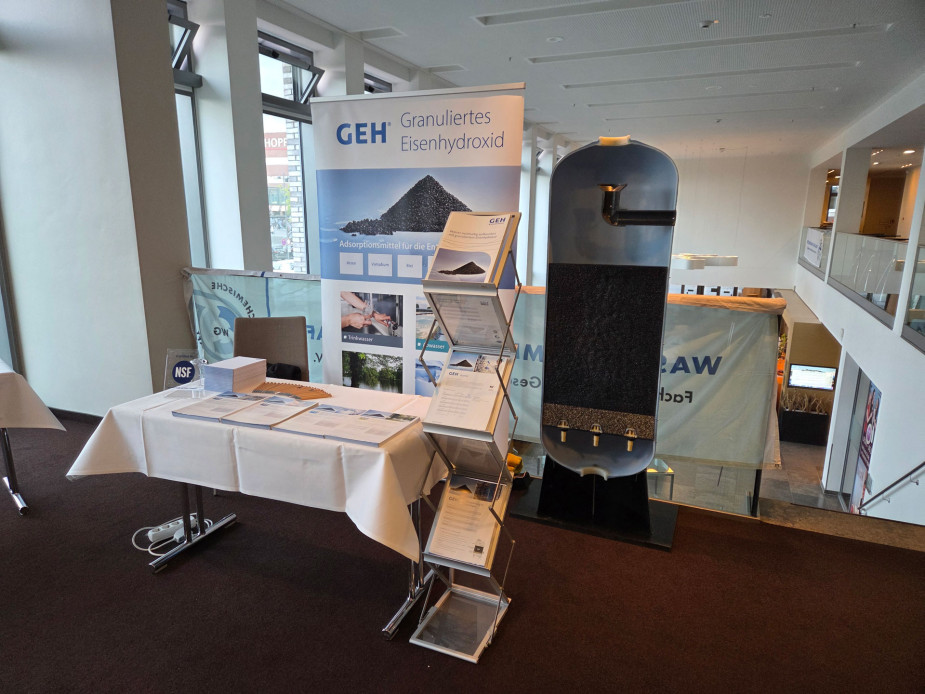
GEH Wasserchemie was represented as a sponsor and exhibitor at the accompanying trade fair. The personal exchange with experts from research and industry provided valuable insights into current issues in water treatment and regulatory developments. It became clear that, in addition to the currently much-discussed organic trace substances, there remains a significant need for robust and proven solutions for the removal of inorganic contaminants. Particularly in the treatment of drinking water, adsorption processes based on iron hydroxide make an important contribution to the safe removal of elements such as arsenic, vanadium, and lead, which remain highly relevant in many applications.
WASSER 2026 impressively demonstrated that, even after a century, water chemistry continues to play a key role in addressing global challenges and is constantly adapting to new issues. We warmly congratulate the Society of Water Chemistry on its 100th anniversary and thank them for an excellently organized and technically outstanding event.
This text was created in part using artificial intelligence (AI) and was editorially reviewed prior to publication.