Adsorption vs. Filtration: Removing Arsenic from Water
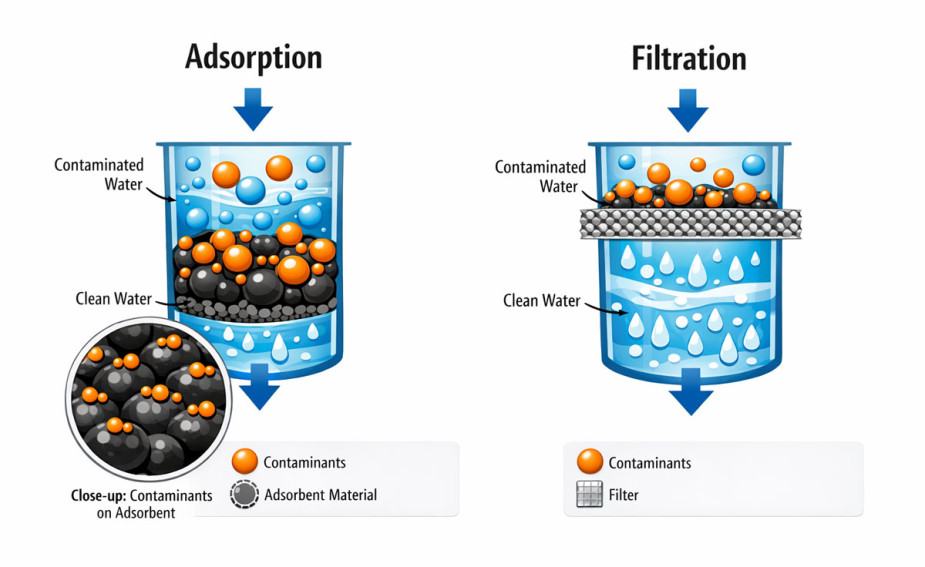
Arsenic contamination in groundwater is a widespread challenge for drinking water supply, industrial water treatment, and decentralized systems worldwide. Because arsenic is present in dissolved form, removing it requires specialized treatment technologies. A reliable arsenic removal filter must therefore do more than mechanically filter particles: it must remove arsenic at the molecular level.
When selecting an effective arsenic filter, it is crucial to understand the difference between filtration and adsorption.
Why Arsenic Cannot Be Removed by Filtration Alone
Conventional filtration is designed to remove suspended solids such as sand, rust, or turbidity. These particles are physically separated based on size, using filter media or membranes.
However, arsenic typically occurs as dissolved ions (As(III) or As(V)) in water. These ions are orders of magnitude smaller than the pore sizes of conventional filter media and therefore pass through unchanged. Therefore, filtration alone cannot reliably remove arsenic from water.
What “Filter Arsenic from Water” Really Means
Although the term arsenic filter is widely used, effective arsenic removal is not achieved through physical filtration. Instead, successful systems rely on adsorption, a process in which arsenic binds to the surface of a specialized medium.
Adsorption – The Core of Every Effective Arsenic Filter
Adsorption is the key mechanism behind modern arsenic removal filter systems. During adsorption, dissolved arsenic ions attach to the surface of materials with a high chemical affinity for arsenic.
Common adsorption media include:
- granular ferric hydroxide
- activated alumina
- engineered hybrid media
These materials provide a large active surface area, allowing arsenic adsorption even at very low concentrations.
An often-cited exception is the precipitation–filtration process. In this approach, a coagulant such as ferric chloride is added to the raw water, forming iron hydroxide precipitates. Dissolved arsenic species are transferred from the aqueous phase to the solid phase by adsorption and co-precipitation onto these freshly formed iron hydroxide flocs.
The flocs are subsequently removed by filtration or sedimentation. While filtration is used to separate the solids from the treated water, the actual removal mechanism remains adsorption, as arsenic binds chemically to the surface of the iron hydroxide solids rather than being removed by size-based filtration alone.
Adsorption vs. Filtration – A Clear Comparison
Filtration and adsorption serve different purposes in water treatment:
- Filtration removes suspended particles and protects downstream systems
- Adsorption removes dissolved contaminants such as arsenic
In practice, highperformance arsenic removal systems combine both processes: prefiltration followed by adsorption.
Only adsorption enables a filter to reliably meet drinking water standards for arsenic.
Criteria for Selecting an Arsenic Removal Filter
When evaluating a solution to filter arsenic from water, several factors must be considered:
- Arsenic species: As(III) and As(V) behave differently
- Water chemistry: pH, phosphate, silicate, and iron influence performance
- Media capacity: determines filter lifetime and operating cost
- Process stability: consistent compliance with regulatory limits
A welldesigned arsenic filter must be tailored to the specific water composition and application.
Talk to Our Water Treatment Experts
Are you looking for a reliable solution to remove arsenic from your water? Our experts will help you select and design the right arsenic removal filter for your specific application.
Contact us to learn how to filter arsenic from water safely and efficiently.